After Isaac blesses Jacob as the first born instead of Esau, and in which Jacob takes a double portion of the family goods and becomes the leader of the household, Rebekah fears Esau will take revenge and kill her son. So she tells him to quickly leave for her brother’s household and approaches Isaac for his consent:
And Rebekah said to Isaac: 'I am weary of my life because of the daughters of Heth. If Jacob take a wife of the daughters of Heth, such as these, of the daughters of the land, what good shall my life do me?' Gen. 27:46
In the verse, Rebekah appears to be telling a white lie to her husband in order for Jacob to escape the vengeance of his brother Esau – or is she? If we look carefully at the verse in the Hebrew Bible, we note that the word ‘weary’ Katzti קַצְתִּי is written with a small koof ק. The question is why?
The gematrical summation of the word Katzti,קצתי = koof-tzadik-taf-yod = 100+90+400+10 = 600, but if we delete the value of the small koof ק = 100, it is 500.
As we know, the significance of 500 is found in the word pru oo rabu פרו ורבו,be fruitful and multiply, and signifies the perpetuation of the human race through generation after generation, beyond the realm of 400. The completion of a cycle and the beginning of a new cycle. Hence, what Rebekah is really telling Isaac is not only to save the life of their son, but more importantly, to fulfill God’s promise to Abraham and Isaac, and in particularly, Isaac’s blessing to Jacob - And your seed shall be as the dust of the earth: (Gen 28:14) through the original seed of Terah, her own family. Certainly, she does not want the generations of the future Jewish race to be founded on the Canaanites – the daughters of Heth. Indeed, as we know, Jacob, after marrying Rachel and Leah, fathers the twelve tribes of Israel who later go down to Egypt as seventy souls and leave Egypt some 400 hundred years later as 600,000 souls. Hence, it was the foresight and wisdom of Rebekah, the mother of the third patriarch, (See Rebekah and the Camels), that the generations of the Hebrew race is preserved.
Circumcision: The union of Heaven and Earth
One of the most important events in the evolution of the Hebrew race is the circumcision described in Genesis 17. Its importance is emphasized inasmuch that it covers 6 verses and ends with the phrase that any male who is not circumcised shall be ‘cut off from his people’
And God said to Abraham, You shall keep my covenant therefore, you, and your seed after you in their generations: This is my covenant, which you shall keep, between me and you and your seed after you; Every male child among you shall be circumcised: And you shall circumcise the flesh of your foreskin; and it shall be a sign of the covenant between me and you: And he who is eight days old shall be circumcised among you, every male child in your generations, he who is born in the house, or bought with money from any stranger, who is not of your seed: He who is born in your house, and he who is bought with your money, must be circumcised; and my covenant shall be in your flesh for an everlasting covenant: And the uncircumcised male child whose flesh of his foreskin is not circumcised, that soul shall be cut off from his people; he has broken my covenant(Gen. 17: 9-14).
In the same chapter God emphasizes that: He will make his covenant with Abraham and Sarah (The names of Abram and Sarai will be changed to Abraham and Sarah); and Sarah will give birth to a son called Isaac, and God will make His covenant with Isaac whose seed will become a great nation; Kings will be born from his seed.
In the text it is emphasized that the circumcision will take place on the ‘eighth day’ and where the number eight, covenant and circumcision are inseparable. Let us look at the number ‘8’ more closely:
In Hebrew ‘8’ is shemoneh שמונה spelled shin-mem-vav-nun-hehשמונה and has the same root as for ‘oil’ shemen, שמן shin-mem-nun which has a gematrical value of 300-40-50 = 390. It is the same value as the word for ‘heaven’, shemayim spelled shin-mem-yod-mem שמים = 300+40+10+50 = 390. So, we see a certain link between 8, oil and heaven.
Moreover, the Hebrew word for ‘soul’ neshamah and ‘breath’ neshimah both come from the same root nesham נשם spelled nun-shin-mem = 50+300+40 = 390, which is the same as heaven. So, again, we see that the circumcision, taking place on the 8th day, is not random, but specifically emphasizes the importance of a covenant between God and the ‘soul of man’ and where it says: I will take you to be your God and you will be my people (Ex. 6:7).
If we look further, the Hebrew word for ‘circumcise’ is mila spelled mem-yod-lamed-heh מילה of which the root letters are mem-yod-lamed מיל = 40-10-30 = 80 which is a decane above 8 and would indicate that the act of circumcision is not only physical but also affecting the consciousness. Similarly, the word for foreskin is orela spelled ayin-vav-resh-lamed-heh עורלה, whereby the root letters are ayin-resh-lamed ערל = 70-200-30 = 300 which is the expanded form (milui)[1] for the Hebrew word for God, Elohim אלהים and signifies the yang; the force of Heaven, male, and has the power of creation. So it is through the circumcision, through the very organ through which our body reproduces itself, that power of Heaven enters into the female co-joining the force of the Earth to produce a human being containing both forces of Heaven and Earth.
However the question arises: why does the circumcision occur in the 8th day? What is special about that day? The 8th day is after the 7th, the Sabbath, which in turn is celebrated after 6 days of work where our consciousness is fixed to this physical plane. The purpose of the 7th day is not only to rest, but more important, to prepare ourselves for the next world, the world of the 8th day, which is a new cycle of consciousness. So, on the Sabbath day we allow our consciousness to transcend the physical needs of this world by placing a gader or fence around our existence for that day so we can realize God.
In this context one can see the form of the word Shabbat, the seventh day, spelled shin-beth-taf ,שבת with the gematrical values of 300-2-400, where 300, as mentioned earlier, represents Heaven, the male force, the Yang and 400 is Earth, the female force, the Yin. So it is that in the Bible we have 3 patriarchs, Abraham, Isaac and Jacob, and 4 matriarchs, Sarah, Rebekah, Rachel and Leah. The beth, ב, in the word Shabbat שבת has the symbol of ‘beit’ meaning home and has a value of 2. So, Shabbat is the union of the spiritual male and the spiritual female in the home.
[1] Milui a form of gematrical analysis when each letter of a word is spelled in its full form. Hence the milui gematria for the name of God, Elohim, אלהים , spelled aleph-lamed-heh-yod-mem is: aleph א spelled: aleph-lamed-peh = 1+30+80=111; lamed ל spelled: lamed-mem-daled = 30+40+4=74; hei ה spelled: hei-yod = 5+10 =15; yod י spelled: yod-vav-daled = 10+6+4=20; mem ם spelled: mem-mem = 40+40=80. Total =111+74+15+20+80 = 300
Sarah and the Cave of Machpelah
And Sarah was a hundred and twenty-seven years old; these were the years of Sarah. And Sarah died in Kirjath-arba (Gen. 23:1-2).
And he (Abraham) stood up and bowed himself to the people of the land, even the Children of Chet, and communed with them saying, if it be your mind that I should bury my dead out of my sight; and entreat for me to Ephron (the Hittite), the son of Zohar, that he may give me the Cave of Machpelah… (Gen. 23:8-9).
And Ephron answered saying unto him, My Lord, hearken unto me: the land is worth four hundred shekels of silver (Gen. 23:14-15).
The purchase of the Cave of Machpelah as a tomb for Sarah was an extraordinary vision of the future on the part of Abraham. The lengthy description of the process of the purchase of Sarah’s burial place more than of that of any other personage in the Torah. In all other passages concerning the death of the patriarchs and the matriarchs, including the deaths of Moses and Aaron, the expression of death is short and quick … ‘and he died …’; ‘and he was buried…’. What is so special about this case?
The word Machpelah, מכפלה spelled mem-caph-peh-lamed-heh, is derived from the word caphul, כפלspelled caph-peh-lamed, which means ‘double’. Hence, ‘the Cave of Machpelah’ means ‘the Cave of the Doubling’. The ‘doubling’ foreshadows the events to come, whereby the cave becomes not only a tomb for Sarah, but later a mausoleum for the three patriarchs and three of the matriarchs (excepting Rachel, who was buried on the road to Bethlehem after giving birth to Benjamin (Gen. 35:19)). Later Abraham is buried together with Sarah, Isaac with Rebekah and Jacob with Leah. In accord with The Zohar Adam and Eve were also buried in this cave, hence making the total 8 persons or 4 couples buried in the mausoleum.
The cave was in the land of the Children of the Hittites or Beni Chet בני חת. In Hebrew, Hittite is Chet, חת spelled chet-taf and is actually the spelling of the letter ח chet, the eighth letter of the alphabet with the value of 8. The significance of 8 is associated with a covenant with God. Astrologically, eight is associated with the eighth house, which is associated with death and Scorpio, with its tail curling around towards its head, with the concept of death and rebirth. The number 8 is also associated with 50 because just as 7+1=8, so 7x7+1= 50. Fifty means renewal, return and beginning of a new cycle beyond this world. Moreover, the spelling of chet has a gematrical sequence 8-400, and 400, as we know, is the highest level of spirituality that man can reach on the earthly plane before going on to the next world.
More specifically the cave was purchased from Ephron the Hittite. Ephron עפרון is spelled ayin-peh-resh-vav-nun where the root letters of Ephron are apharעפר meaning ‘dust’. It is related to the phrase: from dust you were made and to dust you shall return, (Gen. 3:19). Hence ‘Ephron the Hittite’ actually means ‘dust of the eight’ which could be interpreted as the ‘dust of return’ or ‘dust of the covenant with God’[1]. Aphar עפר has a value of 70+80+200=350. It is half of 700, the spiritual Sabbath, and the same value as oref ערפ meaning neck, which is the connecting link between the heavenly soul neshama נשמה and the bodily soul, nefeshנפש .
In the text, the name Ephron is spelled in two ways, with the vav (Gen. 23: 8-17) i.e. עפרון ayin-peh-resh-vav-nun, and without the vav: עפרן ayin-peh-resh-nun = 70+80+200+50 =400 (Gen. 25:9).
As we know, the symbol of vav is a hook, and nun has a value of 50. So here the sequence of the letters in the word Ephron ayin-peh-resh-vav-nun, links aphar, (dust), with the 50 meaning return and renewal. So, this spelling of Ephron represents the dust that we become after death to 50 which means renewal or the beginning of a new cycle. Thus, it can be said that the dust of Sarah goes through the process of death and rebirth.
In the latter spelling of Ephron the gematrical value is 400 which is the amount in shekels that Abraham pays to purchase the Cave of Machpelah. Moreover, shekel, שקל spelled shin-koof-lamed, (300+100+30) has a value of 430, which is the same value as that for nefeshנפש spelled nun-peh-shin(50+80+300=430) meaning ‘bodily soul’.
So, if we look at the gematrical connotations of the purchase of the Cave of Machpelah, it goes far beyond simply finding a place to bury the beloved wife of Abraham. The ultimate intention was that it would be the burial place for the three patriarchs and their wives in order that their souls could reach the highest level of spiritual development (400), and that upon death, the bodily soul, the nefesh (430) would return to dust aphar (350) and the heavenly soul neshama would pass through the 8 to the next world.
Not only this, but in each reference to the Cave of Machpelah both during the purchase of the tomb and the subsequent burials of the patriarchs, Abraham, Isaac and Jacob, it is always noted that it was ‘before Mamre,’ which was the place where Abraham lived (See Gen. 23:17; Gen. 23:19; Gen. 25:9; Gen. 35:27; Gen. 49:30; Gen. 50:13).
And the field of Ephron, which was in Machpelah, which was before Mamre, the field, and the cave which was in it, and all the trees that were in the field, that were in all the borders around, were made over (Gen. 23:17)
The gematrical value 281 is the same as for apharאפר meaning ash and spelled aleph-peh-resh = 1+80+200. Hence again the association of the burial place and a location for the finite particles that become the remnant of the bodily soul, the nefesh.
In Hebrew, the phrase ‘dust to dust, ashes to ashes’ is aphar l’aphar, aphar l’aphar עפר לעפר, אפר לאפר where the only difference between the word for dust and ash is that an ayinע is used instead of an aleph אand in many cases in the Bible the word dust is also spelled with an ayin instead of an aleph.
In summary, although the Cave of Machpelah was ostensibly a burial place for the beloved wife of Abraham, its purchase was in fact intended as the burial of the patriarchs and the matriarchs in the Promised Land, several hundred years before the promise of God was realized 40 years after the exodus from Egypt. The purchase of the Cave of Machpelah was therefore critical in determining the future location of the core roots of the genesis of Judaism and the Children of Israel.
[1] For this reason, Hindus and in particular, followers of Shiva, paint ash upon their forehead to remind them that their bodies and the finite form of the phenomenal world is nothing but ash
Sacrifice of Isaac
One of the most significant episodes in the whole Bible is the sacrifice of Isaac. It not only tests Abraham’s faith in the severest possible sense, but also it brings Isaac, the second patriarch, to a state of enlightenment. The place where Isaac was to be sacrificed was Mount Moriah and is synonymous with present-day Temple Mount in Jerusalem.
In Hebrew, the episode of the sacrifice of Isaac is traditionally called the akedameaning ‘the binding’ and is related to the sentence:
And they came to the place which God had told him of; and Abraham built and altar there, and laid the wood in order, and bound Isaac his son, and laid him on the altar upon the wood (Gen. 22:8).
Bind, or aked עקד is normally applied to sacrificial animals where the four legs of the animal are bound together to form ‘one’. In the case of Isaac his two arms and legs were bound together to form ‘one’. Effectively the act of sacrifice is the act of bringing the ‘four’ of the phenomenal world back to the ‘one’ of the Creator. It is the inverse of the Act of Creation in Genesis in which ‘the four’, the phenomenal world, is created from ‘the one’ i.e. God; hence the phrase:
‘from dust you were formed and to dust you shall return’ (Gen. 3:19).
Isaac, as the second patriarch, was unique inasmuch he is the only person to have undergone a near-death experience when he was about to be sacrificed. The binding akeda of his four limbs into the ‘one’ brought him to Paradise, the Garden of Eden. As his jugular vein was about to be cut, and his blood was about to flow upon the altar of God, he was brought back from the dead, from the ‘one’ back to the ‘four’. This made Isaac unique. He had seen Paradise,
This is seen from the word binding[1] or akeda, עקדה, spelled: ayin-koof-daled-heh = 70+100+4+5=179. It has the same gematrical value as ‘the Garden of Eden’, גן בעדן = gimel-nun-beth-ayin-dalet-nun = 3+50+2+70+4+50 = 179 which is ½ the value for Messiah, משיח = mem-shin-yod-chet =40+300+10+8 = 358. Hence when Abraham and Isaac enter Mt. Moriah, they are in fact entering the Garden of Eden, Paradise, where all humanity began and, as we note in the post Lech Lecha is also the Land of the Messiah.
Moreover, Isaac is the first person born through the act of circumcision, through a covenant with God. He is therefore the first person to achieve a state of purity and covenant with God. From henceforth any issue from his seed, and the generations that follow, will be pure and with a covenant with God.
[1] Binding a body at death is common practice in many cultures. In Tibet, in the ceremony of sky burials, the body, the arms and the legs are bound together in white cloth and then the bound body is carried by a lama on his back around a stone altar, nine times. It is then placed on the altar and cut into pieces and offered to the vultures and eagles. Hence the Tibetan sky burial also re-enacts the return of the four into the one. Tibetans have four kinds of burial, as represented by the elements Earth, Air, Fire and Water. The sky burial (Air) is for the common man who offers his body to be recycled in the phenomenal world. Cremation (Fire), is for high Lamas whose bodies are considered so powerful that they should not be recycled to lower beings; water burial is for those living near water. Earth burials are considered the lowest form of burial and quite undesirable.
Abram and Sarai
If we turn to Genesis 17, we find that Abraham was originally called Abram and his wife Sarah was originally called Sarai. Sarai, barren all these years, felt anger towards Hagar, her bondservant, who had given birth to Ishmael. God announced to Abram that a son would be born to him and his wife Sarai. He also instructed that Abram and Sarai change their names and that Abram and his household be circumcised.
And Abram fell on his face; and God talked with him, saying: As for me, behold, my covenant is with you, and you shall be a father of many nations:Neither shall your name any more be called Abram, but your name shall be Abraham; for a father of many nations have I made you:As for Sarai your wife, you shall not call her name Sarai, but Sarah shall her name be: AndI will bless her, and give you a son also of her; and I will bless her, and she shall be a mother of nations; kings of people shall be of her (Gen. 3:3-16).
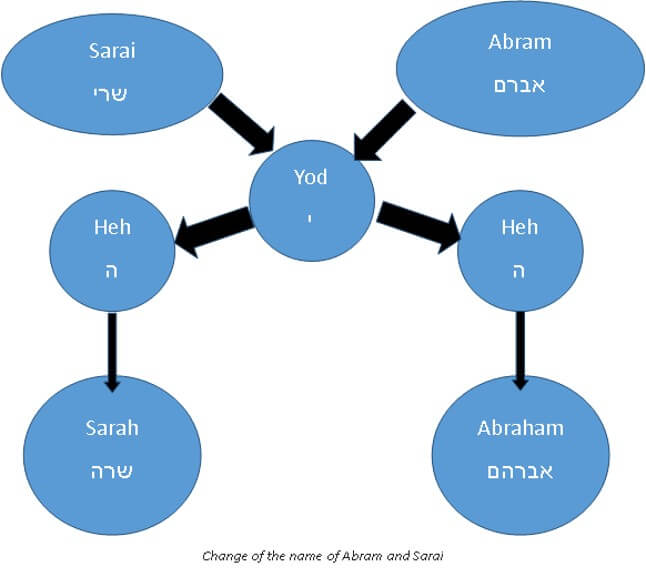
The change of name from Abram, spelled aleph-beth-resh-memאברם to Abraham, spelled aleph-beth-resh-heh-memאברהם is effected by inserting a heh ה. Similarly, in the case of Sarah, her original name was Sarai spelled shin-resh-yodשרי ; God instructed it be changed to Sarah spelled shin-resh-hehשרה. If we look at this change carefully, we can see that a yodי has been taken out of Sarai’s name and replaced by a heh.
It is this insertion of the heh or the ‘5’into the names of Abraham and Sarah that provides the seed and Crystal of Creation that allows Abraham and Sarah to give birth to Isaac, the second patriarch, the father of Jacob and grandfather to the 12 tribes of Israel. Hence God’s promise to Abraham And I will make you exceedingly fruitful, and I will make nations of you, and kings shall come out of you(Gen. 17:6).
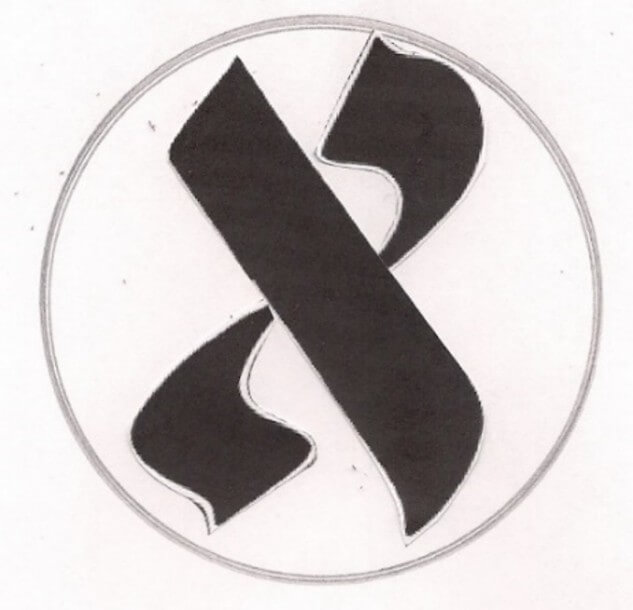
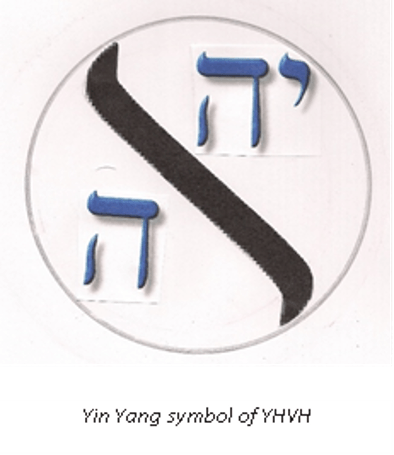
The splitting of the yod into 2 hehs in the renaming of Abram and Sarai, the first patriarch and matriarch, is a direct reflection of the splitting of the lower yodin the letter alephא to create the unspoken word for God YHVH יהוה .
Thus, the aleph א with its composite of yod-vav-yodי-ו-י evolves into yod-heh-vav-hehי-ה-ו-ה which allows the act of Creation to take place (see yin yang symbols in Chapter 1). On the physical plane, Isaac is therefore the product of this evolution.
The importance of the number 5 and the letter hehin gematrical understanding cannot be underestimated. Its composite 1:4 ratio is the representation of God, the 1, and His relationship with the phenomenal plane, the 4. It is the Crystal of Creation, the Crystal of Life.
It should also be noted that once Abram’s name is changed to Abraham and Sarai’s name to Sarah, there is no further reference to their former names throughout the Bible. This is unlike the case of Jacob whose original name is frequently used even after it is changed to Israel.
Gematria of Abram, Hagar and Ishmael
Abram Hagar and Ishmael
The birth of Ishmael to Hagar takes place before Abram’s name is changed to Abraham (Genesis 16:1-16). In the story, because Sarai is barren, she gives her Egyptian bondwoman, Hagar, to Abram in order that Abram would have an heir[1].
However, with the birth of Ishmael Sarai regrets her action and pleads with Abram to evict Hagar and Ishmael, his first-born son, from the home. It is set at a time when Sarai was barren and before the birth of Isaac. It is the second time that Hagar has encountered Sarai’s wrath and fled from her presence (Genesis 16:1-16) and on both occasions God (or the Angel of the Lord) plays a central role in both saving Hagar and her son and encouraging her that her son will become a great nation.
Abram reluctantly agrees to Sarai’s demands and sends Hagar and his son Ishmael into the wilderness with only water and bread. Hagar bewails that her son will soon die of thirst and God answers her plea and a well of water appears. The story then turns to Ishmael whom God says will become a great nation and later we learn he lives in the wilderness to become a great archer and his mother marries him to an Egyptian woman.
There are many interpretations to the story, and which often focus on the harshness of Sarai and how can the mother of all Israel be so cruel. It is said that the story appears on Rosh Hashanah in order to remind us to be benevolent to mankind at this season of forgiveness. Few of these interpretations focus upon the will of God.
Hence, the gematria for Ishmael is 451, the same as for Abram + Hagar.
The relevance of Ishmael in the biblical story tends to be diminished by Rabbis and Hebrew scholars and even regarded with some derision and disdain. However, his importance should not be underestimated, not least because he and generations after him, are blessed by God:
And as for Ishmael, I have heard you; Behold, I have blessed him, and will make him fruitful, and will multiply him exceedingly; twelve princes shall he father, and I will make him a great nation (Gen.17:20).
He was circumcised at the age of 13 (Gen. 17:25) (See the significance of 13 in Chapter 1); his daughter is married to Esau, making an alliance between the two families and forming the foundation of the Islamic race. Moreover, when he died, he was one of six personages privileged to carry the term ‘gathered unto his people’ including the three patriarchs and Aaron and Moses. He was also one of the few to carry the term ‘And these are the generations’ (see Chapter 7).
However, more importantly, Ishmael was Joseph’s great, great uncle and it was the Ishmaelites who were instrumental in bringing the Children of Israel down to Egypt at the time of the famine. Utilizing their ‘dual nationality’ because Hagar was Egyptian and that Ishmael married an Egyptian woman, the Ishmaelites became traders between Egypt and Canaan and the agents of transfer by selling Joseph into Egypt.[2] It was because of Ishmaelites that the Hebrew race were saved from famine.
Most important, the Ishmaelite’s action was a catalyst to the fulfillment of the first commandment given to mankind: ‘Be fruitful and multiply’, Hb. pru oo rabu (Genesis 2:28) and the 70 souls that went down to Egypt became 600,000 (Gen. 46:27; Ex. 12:37). It was Ishmael who enabled, albeit unwittingly, God’s promise to Abraham and Jacob to be fulfilled: And your seed shall be as the dust of the earth (Gen. 28:14) and …. Look now toward heaven, and count the stars, if you are able to count them; and he said to him, So shall your seed be (Gen. 15:5). Ishmael was the agent who transformed the family of Jacob into the Hebrew nation.
Moreover, it should be noted that Ishmael was born when Abram was 86 years old (Gem 16:16). Eighty-six is the gematria for God, Elohim, אלהים = aleph -lamed- heh- yod -mem = 1+30+5+10+40= 86, again implying that the birth og Ishmael was no accident, rather it was ordained by God.
But it is also interesting that the word ‘bow’ appears twice in episode of Hagar and Ishmael (out of seven times in the whole Torah): Once when she is about to leave her son to die in the wilderness and sets him a ‘a bowshot’ away from her (Genesis 21:16), and again in Genesis 21:20 where we are told that Ishmael became an archer, Hb. Roveh Keshet, where the word Keshet means bow. Keshet is the same word as ‘rainbow’ that appeared in the sky after the flood in the story of Noah, in which God made a covenant between Heaven and life on earth promising never again to destroy the life (Genesis 10:13). It is spelled koof-shin-taf קשת = 100-300-400 = 800 where the number 800 is a centane above 8 which is the number representing the physical covenant of the circumcision and in this case 800 indicates a spiritual covenant between Ishmael and God[3]. This statement is very much against the argument of traditional Judaism which regards the seed of Ishmael as an enemy of Israel, yet the context above suggests otherwise: the two sons of Abraham - Ishmael and Isaac - are as the two sons of Isaac – Jacob and Esau. Whilst being diametrically opposite – the Yin and the Yang of mankind, they are necessarily complementary to one another, and the one cannot exist without the other. Rather, for the future sanity of the human race, there is a need for harmony between these two elements.
[1] According to transcriptions found on clay tablets written about mid-nineteenth to eighteenth century BCE, in the region of Mesopotamia where Abraham lived, it was not uncommon, particularly in Nuzi practice, for wives who were barren to give their maidservants to their husband in order to produce heirs.
[2] Unfortunately, the role of the Ishmaelites in human trade perpetuated from this instance right up to the 19th century.
Go Forth - Lech Lecha - לך לך
The title of the third parashah in the Book of Genesis opens with the words ‘Lech Lecha’ לך לך meaning ‘Go You Forth’, where Lech לך means ‘go’ and Lecha לך means ‘you yourself’. These are the instructions from God to Abram to …. Go you forth from your country, and from your family, and from your father's house, to a land that I will show you (Gen. 12:1).
The phrase is interesting, inasmuch that Lech – go – would have been sufficient and the additional Lecha, ‘you yourself’ would seem superfluous. God could have simply said the Abram Lech! ‘Go’ as a commandment, and don’t ask any questions.
The Lecha ‘you yourself’ component has strong implications, since firstly this implies possession of man’s own free will, and therefore he has a choice whether ‘to go or not to go’ (vis a vis Jonah). Secondly, the term Lecha implies an embodiment of the commandment, where God has planted the seed of an idea within the mind of Abram, and it is Abram who embeds the idea in his mind and his soul. Bearing in mind that he came from the land of Ur, that lies in the heart of the fertile crescent of Babylon, where the Tigris and Euphrates Rivers meet makes it the most fertile land in the known world, and where he can enjoy all the creature comforts of the then modern age, yet Abram takes the decision to uproot his entire family and to take them to a land based upon an inner feeling.
If one looks at the gematria for Lech Lechaלך לך lamed-caph, lamed-caph = 30+20= 50 and 30+20=50, one will see that it comprises the doubling of the number 50. Fifty, as described in Chapter 18, is associated with the Jubilee and the Festival of Shavuoth. Fifty means completion of a cycle, when all things return to the beginning and a new cycle begins. In the Jubilee year, all debts are repaid, land which is leased from its owner is returned to its owner, slaves are given their freedom, and a new cycle of counting begins. Fifty means ‘return’ and ‘renewal’, but return to what and renewal of what?
As indicated in parashah Noah, Abram was 58 years old when Noah died. Hence Noah symbolized the end of the Old World and Abram symbolized the beginning of the new. In accordance with the biblical text, Abram left Ur of Chaldees in Babylon and travelled to Haran together with Sarai, his wife, his father, Terah, and the family of Lot. We do not know what age Abram was when he left Ur - maybe 58 - however we do know that he was 75 years old when he left Haran and entered the Land of Canaan:
So, Abram departed, as the Lord had spoken to him; and Lot went with him; and Abram was seventy-five years old when he departed from Haran (Gen. 12:4).
Calculating 75-58=17, the entry into the land of Canaan was 17 years after the death of Noah. As we know from Part I, the number seventeen occurs frequently in biblical texts and is the gematrical number meaning ‘good’ and more significantly ‘change’. Hence, in this instance, the radical and historical change of location of Abram from Haran to the Land of Canaan which took place 17 years after the death of Noah is a subsequent event following the end of physical time that took place as a result of the flood and reflected in the name ‘Noah’.
However, this explanation does not explain why in this parasha it is written Lech Lecha, a double 50implying the concept of return and renewal. Yet if we look further to the verses of Gen. 12:7-8:
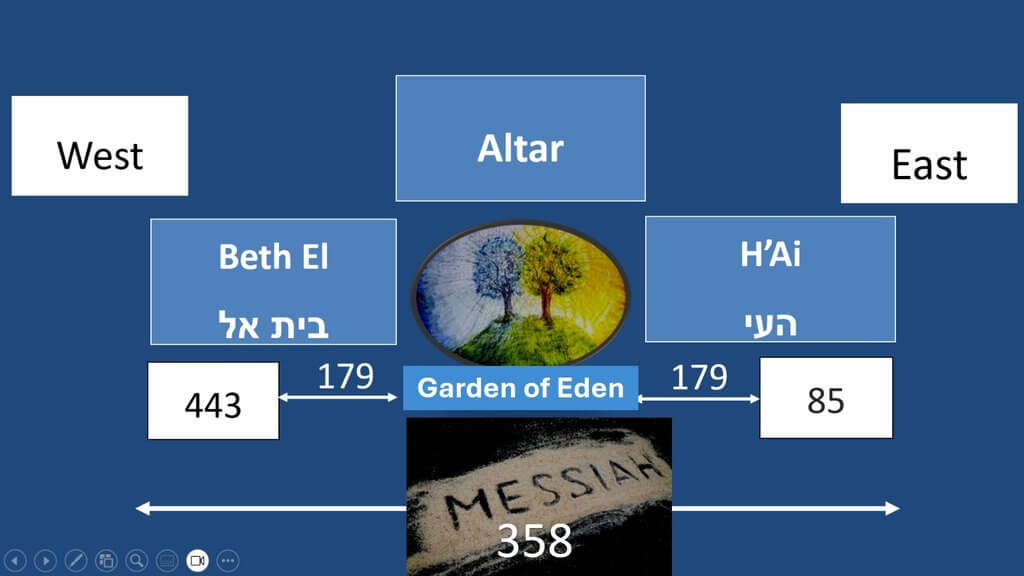
And the Lord appeared unto Abram and said unto thy seed will I give this land: and there builded he an altar unto the Lord who appeared unto him. And he removed from thence unto a mountain on the east of Beth El, and pitched his tent, having Beth El on the west and H’Ai on the east, and there he builded an altar unto the Lord and called upon the name of the Lord.
It can be seen that the point where Abram places the altar is the mid-gematrical distance between Bethel and H’Ai where, Beth El, בת אל meaning the House of God, is spelled; beth-yod-taf-aleph-lamed, and has a gematrical value: 2+10+400+1+30 = 443, and H’Ai העי spelled: heh-ayin-yod, has a value: 5+70+10 = 85. The gematrical distance between the H’Ai and Beth El is therefore 443-85 = 358. Therefore, the mid-point where Abram’s altar was erected, between these two places is 358/2=179. This is the same gematrical value as the Garden of Eden (Gan B’Eden, גן בעדן spelled: gimmel-nun-beth-ayin-daled-nun = 3+50+2+70+4+50 = 179)[1]. Moreover, 358, which the overall gematrical distance between Bethel and Hai is the value for the Messiah, Mashiach,משיח spelled: mem-shin-yod-chet = 40+300+10+8 = 358.
Thus, the central idea of Lech Lecha is not so much to ‘Go Forth’ as implied in the English translation, but to return, meaning to return to the Garden of Eden from which Adam and Eve were evicted. The Garden of Eden was ‘the Promised Land’ given to man before forsaking that right by eating of the Tree of Knowledge of Good and Evil and now it is to be returned 2021 years and 20 generations later to Abram and his seed. The promise made by God is reiterated in the following chapter – Genesis 13:14-17 in which He tells Abraham “Lift up now your eyes, and look from the place where you are to the north, and to the south, and to the east, and to the west. For all the land which you see, to you will I give it, and to your seed forever”.
Then the question arises, what is the meaning of the second ‘50’ of Lech Lecha? It implies that not only is there the renewal and return in the form of going back to the Garden of Eden but further, the renewal in the form of the coming of the Messiah, and that this land is the land of the Messiah.
[1] Several hundred years later, at the time of the exodus, Joshua in his assault on the city of H’Ai, and after successfully conquering Jericho, finds himself in exactly the same place: ‘Joshua therefore sent them forth; and they went to the place of ambush, and stayed between Beth-El and Ai, on the west of Ai’; (Joshua 8:9). Joshua therefore also realises the implications of the place that he was about to conquer and where God had told Abram to establish his altar to be the heart of the Land of Canaan and the Garden of Eden where the Messiah will appear.
Gematria of The Mist, The Garden of Eden, The two trees and man
Why did Reuben sleep with his father's concubine, Bilhah
An extraordinary verse appears immediately after the death of Rachel, Jacob’s dearest wife, whilst giving birth to Benjamin.
And it came to pass, when Israel dwelt in the land, that Reuben went and lay with Bilhah his father’s concubine: and Israel heard it. Now the sons of Jacob were twelve (Gen. 35:22).
Three questions arise: (i) why are the different names Israeland Jacobusedeven though the two sentences are adjacent to each other? (ii) why did Reuben venture to sleep with Rachel’s maidservant, Bilhah? and (iii) why are we told ‘out of the blue’ that the sons of Jacob are twelve?
After Reuben sleeps with Bilhah, the Bible states ‘And Israel heard it” and immediately afterwards it states: “Now the sons of Jacob were twelve”. For this act Reuben, the first born, is chastised by Israel not only in this instance, but also in his blessing of Reuben at the time of Jacob’s death.
Reuben thou art my firstborn, my might and the beginning of my strength, the excellency of dignity, and the excellency of power: Unstable as water, thou shalt not excel, because thou wentest up to thy father’s bed and then defilest thou it; he went up to my couch (Gen. 49:3-4).
Reuben lost favor with his father ever since even until his death, so why did he do it? As we have seen previously, Reuben, as the firstborn, was always very concerned about the fertility of his parents and the number of his brothers. In the incident of the mandrakes it is Reuben who delivers the mandrakes to his mother Leah after the birth of Asher, the 8th child. It is Reuben who sees that his mother has stopped becoming pregnant. He knows that Rachel is barren and so he tries to induce pregnancy of his mother by using mandrakes. Later in the story the mandrakes get passed on to Rachel, giving rise to the birth of Joseph (Chapter 8).
Reuben understood that there should be thirteen sons of Jacob, - and therefore 13 tribes of Israel - and not twelve, and that the 13th son should be from Rachel’s womb, or at least from her maidservant’s, which would count as the same thing[1]. So, after the death of Rachel he takes Rachel’s maidservant, Bilhah, and sleeps with her, hoping to increase the number of the tribes of Israel to 13. Hence, the sentence: “Now the sons of Jacob were twelve”. This ploy was not successful, and Bilhah does not become pregnant.
Later, we again see Reuben’s concern over the number of brothers and tribes of Israel. When his brothers intend to slay Joseph, it is Reuben who desperately tries to save him that he might deliver him to his father again.
And Reuben heard it, and he saved him from their hands; and said, Let us not kill him: And Reuben said to them, Shed no blood, but throw him into this pit that is in the wilderness, and lay no hand upon him; that he might rid him from their hands, to deliver him to his father again (Gen. 37:21-22).
Reuben’s concern and despair is further realized when he returns to the pit into which Joseph was thrown and finds him gone, for if Joseph is slain there would only be 11 sons.
And Reuben returned to the pit; and, behold, Joseph was not in the pit; and he tore his clothes (Gen.37:21-22).
However, it is God who decides how and when there should be thirteen tribes of Israel, as indeed He does through the birth of Ephraim and Manasseh, the sons of Joseph, who indirectly come through Rachel’s womb. Jacob very explicitly incorporated Ephraim and Manasseh into the tribes of Israel when he blessed them on his deathbed, saying:
And now your two sons, Ephraim and Manasseh, who were born to you in the land of Egypt before I came to you to Egypt, are mine; as Reuben and Simeon, they shall be mine: And your issue, born to you after them, shall be yours, and shall be called after the name of their brothers in their inheritance (Gen. 48:5-6)
In thee shall Israel bless, saying God make these as Ephraim and Manasseh(Gen. 48:20).
Here again we see that when Reuben sleeps with Bilhah and in the blessing of Ephraim and Manasseh, the name ‘Israel’ is used instead of Jacob. Moreover, Jacob states very clearly that any sons born after Ephraim and Manasseh shall not be numbered as Jacob’s offspring, but shall be Joseph’s.
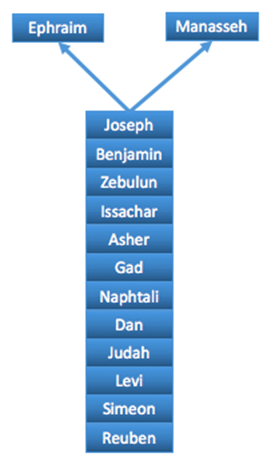
The tribes of Israel can best be described in the diagram below, where Joseph fits the blessing of Jacob, saying:
Joseph is a fruitful bough, a fruitful bough by a well; whose branches run over the wall (Gen. 49:22).
The very structure of the diagram shows that the two sons of Joseph are indeed like a fruitful bough whose branches run over the wall. What does it mean? The tribes of Israel are like a tree that continues to develop, evolve, change, learn, invent, explore into the unknown over the wall and go through continual renewal.
Moreover, 13 is the gematrical value of the letter of the word ‘one’ achad, אחד , showing that the thirteen tribes possess unity within their diversity. Thirteen is half the value of the components of the letter alephא, and of the tetragrammaton YHVH both of which have a value of 26; thirteen denotes the qualities of God and, not least, 13 is the gematrical value for love, (see Chapter 1).The unity of the thirteen tribes of Israel on earth is complemented by the unity of God in Heaven and that unity is the unity of LOVE.
Twelve is a static number; there is no growth, evolution or development. It is confined and limited; it has no movement or change. Twelve is the measure of the phenomenal world, whereas thirteen is the measure of unity. Twelve is for the tribes Ishmael:
And as for Ishmael, I have heard you; Behold, I have blessed him, and will make him fruitful, and will multiply him exceedingly; twelve princes shall he father, and I will make him a great nation (Gen. 17:20).
The 13 Tribes of Israel
[1] According to Nuzi tablets in the Mesopotamia region, it was common for a wife to give her maidservant to her husband should she be barren; a child of a maidservant would be treated as a child of the wife.
The Mandrake Incident
In the procession of births of the sons of Jacob indicated in Genesis 29 and 30, we come across an extraordinary interlude in which Reuben brings mandrakes for his mother, Leah; Rachel then barters with Leah, offering her husband Jacob for that night in exchange for the mandrakes (Gen. 30:13-16).
This is the first of three instances where Reuben, the first-born, demonstrates his concern about the fertility of his father’s wives and concubines, or rather, about the number of tribes of Israel that are born. (Seehttps://thealeph.leonvdk.com/uncategorized/why-did-reuben-sleep-with-his-fathers-concubine-bilhah/). Why did Reuben take it upon himself to bring mandrakes to his mother and why is ‘the mandrake incident’ mentioned in the middle of the sequence of births formulating the tribes of the Children of Israel? We suspect that this incident signals that something special is going to happen. The mandrake incident occurs after the birth of Asher, who is the 8th son and born during the wheat harvest.
The mandrake is a very powerful plant. It is said that the root has human shape and anyone who uproots the mandrake from the ground will die. Ancient lore has it that the mandrake fell into Reuben’s hands via his donkey which, struggling to get free of the bush he was tied to, uprooted the mandrake and consequently died.
The mandrake brings male and female together through the aroma it produces. In the love songs of Solomon it reads: The mandrakes give aroma, and at our gates are all manner of pleasant fruits, new and old, which I have laid up for thee, O my beloved (Songs of Songs 7:14) [1]. It is for this reason that the verse Lecha Dodi ‘Come my beloved’ in the Song of Songs, is sung during the Friday evening service to welcome in the Sabbath and is likened to welcoming a bride, or heaven coming to earth on the Sabbath eve.
The Hebrew word for mandrake is dodeim דודאים spelled: daled-vav-daled-aleph-yod-mem with a gematrical value of 4+6+4+1+10+40=65. Sixty-five is 5 x 13 where 5 is the number of the Crystal of Creation and 13 is the gematrical value for LOVE אהבה spelled aleph-heh-beth-heh= 1+5+2+5=13.
The word for mandrake is derived from the root word, dod, דוד spelled daled-vav-daled with a gematrical value of 4+6+4=14. Dod means both ‘uncle’ and ‘beloved’ and is also the spelling for the name ‘David.’[2][3] As we know, the vav symbolizes a hook. Just as the letter alephcomprises two yods connected by a vav on either side representing the binding of God in Heaven and God on Earth, (see Chapter 1), soin this case the vav is binding the two daleds on either side, meaning the binding of male and female in the phenomenal world, represented by the number 4. This force that binds the two together is the force of love. It is for this reason that the Song of Songs is read during the Sabbath evening service, and the welcoming of the Sabbath is likened to the welcoming of a bride, binding Heaven and Earth and male and female forces together.
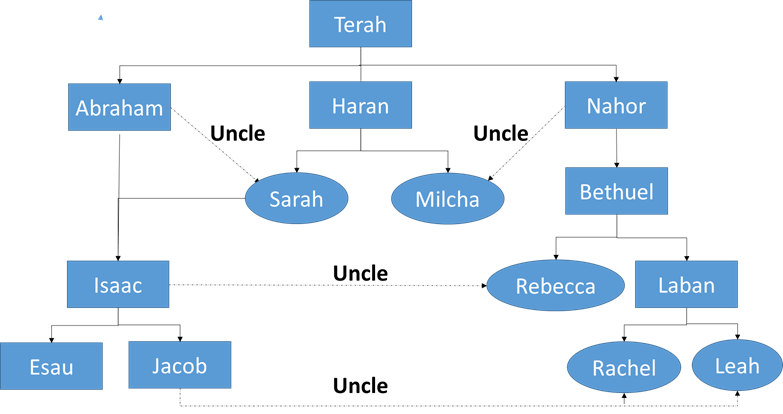
Similarly, considering dod as the Hebrew word for uncle, if we examine the family tree of the three patriarchs we see that they were in fact uncles to their wives [4] and that the union of male and female was indeed ‘the beloved’. The union of the three patriarchs, Abraham, Isaac and Jacob to their wives Sarah, Rebecca, Rachel and Leah was a union of love. The birth of the Hebrew race was founded on LOVE.
Abraham, Isaac and Jacob were uncles to their wives
[1] The word ‘my beloved’, dodi and ‘mandrake’ dodeim, are from the same word root.
[2] In Hebrew, the vav ו can either be pronounced as an ‘o’ or ‘oo’ sound or as a ‘v’ sound.
[3] It is for this reason there are 14 Stations of the Cross along the Via Dolorosa in Jerusalem because it is interpreted from Isaiah 11:1 that the Messiah will be a descendent of King David.
[4] For this reason, both Abraham and Isaac escape perjury when allowing their wives to become concubines to Abimelech, claiming that they were their sisters, which was a common reference relating not only to an actual sister but also to close relatives (Gen. 20:9; 26:8).