Circumcision: The union of Heaven and Earth

One of the most important events in the evolution of the Hebrew race is the circumcision described in Genesis 17. Its importance is emphasized inasmuch  that it covers 6 verses and ends with the phrase that any male who is not circumcised shall be ‘cut off from his people’

And God said to Abraham, You shall keep my covenant therefore, you, and your seed after you in their generations: This is my covenant, which you shall keep, between me and you and your seed after you; Every male child among you shall be circumcised: And you shall circumcise the flesh of your foreskin; and it shall be a sign of the covenant between me and you: And he who is eight days old shall be circumcised among you, every male child in your generations, he who is born in the house, or bought with money from any stranger, who is not of your seed: He who is born in your house, and he who is bought with your money, must be circumcised; and my covenant shall be in your flesh for an everlasting covenant: And the uncircumcised male child whose flesh of his foreskin is not circumcised, that soul shall be cut off from his people; he has broken my covenant (Gen. 17: 9-14).

In the same chapter God emphasizes that: He will make his covenant with Abraham and Sarah (The names of Abram and Sarai will be changed to Abraham and Sarah); and Sarah will give birth to a son called Isaac, and God will make His covenant with Isaac whose seed will become a great nation; Kings will be born from his seed.

In the text it is emphasized that the circumcision will take place on the ‘eighth day’ and where the number eight, covenant and circumcision are inseparable. Let us look at the number ‘8’ more closely:

In Hebrew ‘8’ is shemoneh שמונה spelled shin-mem-vav-nun-heh שמונה and has the same root as for ‘oil’ shemen, שמן shin-mem-nun which has a gematrical value of 300-40-50 = 390. It is the same value as the word for ‘heaven’, shemayim spelled shin-mem-yod-mem שמים = 300+40+10+50 = 390. So, we see a certain link between 8, oil and heaven.

Moreover, the Hebrew word for ‘soul’ neshamah and ‘breath’ neshimah both come from the same root nesham נשם spelled nun-shin-mem  = 50+300+40 = 390, which is the same as heaven. So, again, we see that the circumcision, taking place on the 8th day, is not random, but specifically emphasizes the importance of a covenant between God and the ‘soul of man’ and where it says: I will take you to be your God and you will be my people (Ex. 6:7).

If we look further, the Hebrew word for ‘circumcise’ is mila spelled mem-yod-lamed-heh מילה of which the root letters are mem-yod-lamed מיל = 40-10-30 = 80 which is a decane above 8 and would indicate that the act of circumcision is not only physical but also affecting the consciousness. Similarly, the word for foreskin is orela spelled ayin-vav-resh-lamed-heh עורלה, whereby the root letters are ayin-resh-lamed ערל = 70-200-30 = 300 which is the expanded form (milui)[1] for the Hebrew word for God, Elohim אלהים  and  signifies the yang; the force of Heaven, male, and has the power of creation. So it is through the circumcision, through the very organ through which our body reproduces itself, that power of Heaven enters into the female co-joining the force of the Earth to produce a human being containing both forces of Heaven and Earth.

However the question arises: why does the circumcision occur in the 8th day? What is special about that day? The 8th day is after the 7th, the Sabbath, which in turn is celebrated after 6 days of work where our consciousness is fixed to this physical plane. The purpose of the 7th day is not only to rest, but more important, to prepare ourselves for the next world, the world of the 8th day, which is a new cycle of consciousness. So, on the Sabbath day we allow our consciousness to transcend the physical needs of this world by placing a gader or fence around our existence for that day so we can realize God.

In this context one can see the form of the word Shabbat, the seventh day, spelled shin-beth-taf  ,שבת with the gematrical values of 300-2-400, where 300, as mentioned earlier, represents Heaven, the male force, the Yang and 400 is Earth, the female force, the Yin. So it is that in the Bible we have 3 patriarchs, Abraham, Isaac and Jacob, and 4 matriarchs, Sarah, Rebekah, Rachel and Leah. The beth, ב, in the word Shabbat שבת has the symbol of ‘beit’ meaning home and has a value of 2. So, Shabbat is the union of the spiritual male and the spiritual female in the home.


[1] Milui a form of gematrical analysis when each letter of a word is spelled in its full form. Hence the milui gematria for the name of God, Elohim, אלהים , spelled aleph-lamed-heh-yod-mem is: aleph א spelled: aleph-lamed-peh = 1+30+80=111; lamed ל spelled: lamed-mem-daled = 30+40+4=74; hei ה spelled: hei-yod = 5+10 =15; yod י spelled: yod-vav-daled = 10+6+4=20; mem ם spelled: mem-mem = 40+40=80. Total =111+74+15+20+80 = 300
Sacrifice of Isaac

One of the most significant episodes in the whole Bible is the sacrifice of Isaac. It not only tests Abraham’s faith in the severest possible sense, but also it brings Isaac, the second patriarch, to a state of enlightenment. The place where Isaac was to be sacrificed was Mount Moriah and is synonymous with present-day Temple Mount in Jerusalem.

In Hebrew, the episode of the sacrifice of Isaac is traditionally called the akeda meaning ‘the binding’ and is related to the sentence:

And they came to the place which God had told him of; and Abraham built and altar there, and laid the wood in order, and bound Isaac his son, and laid him on the altar upon the wood (Gen. 22:8).

Bind, or aked עקד is normally applied to sacrificial animals where the four legs of the animal are bound together to form ‘one’. In the case of Isaac his two arms and legs were bound together to form ‘one’. Effectively the act of sacrifice is the act of bringing the ‘four’ of the phenomenal world back to the ‘one’ of the Creator. It is the inverse of the Act of Creation in Genesis in which ‘the four’, the phenomenal world, is created from ‘the one’ i.e. God; hence the phrase:

‘from dust you were formed and to dust you shall return’ (Gen. 3:19).

Isaac, as the second patriarch, was unique inasmuch he is the only person to have undergone a near-death experience when he was about to be sacrificed. The binding akeda of his four limbs into the ‘one’ brought him to Paradise, the Garden of Eden. As his jugular vein was about to be cut, and his blood was about to flow upon the altar of God, he was brought back from the dead, from the ‘one’ back to the ‘four’. This made Isaac unique. He had seen Paradise,

This is seen from the word binding[1] or akeda, עקדה, spelled: ayin-koof-daled-heh = 70+100+4+5=179. It has the same gematrical value as ‘the Garden of Eden’, גן בעדן = gimel-nun-beth-ayin-dalet-nun = 3+50+2+70+4+50 = 179 which is ½ the value for Messiah, משיח = mem-shin-yod-chet =40+300+10+8 = 358. Hence when Abraham and Isaac enter Mt. Moriah, they are in fact entering the Garden of Eden, Paradise, where all humanity began and, as we note in the post Lech Lecha is also the Land of the Messiah.

Moreover, Isaac is the first person born through the act of circumcision, through a covenant with God. He is therefore the first person to achieve a state of purity and covenant with God. From henceforth any issue from his seed, and the generations that follow, will be pure and with a covenant with God.


[1] Binding a body at death is common practice in many cultures. In Tibet, in the ceremony of sky burials, the body, the arms and the legs are bound together in white cloth and then the bound body is carried by a lama on his back around a stone altar, nine times. It is then placed on the altar and cut into pieces and offered to the vultures and eagles. Hence the Tibetan sky burial also re-enacts the return of the four into the one. Tibetans have four kinds of burial, as represented by the elements Earth, Air, Fire and Water. The sky burial (Air) is for the common man who offers his body to be recycled in the phenomenal world. Cremation (Fire), is for high Lamas whose bodies are considered so powerful that they should not be recycled to lower beings; water burial is for those living near water. Earth burials are considered the lowest form of burial and quite undesirable.

Abram and Sarai

If we turn to Genesis 17, we find that Abraham was originally called Abram and his wife Sarah was originally called Sarai. Sarai, barren all these years, felt anger towards Hagar, her bondservant, who had given birth to Ishmael. God announced to Abram that a son would be born to him and his wife Sarai. He also instructed that Abram and Sarai change their names and that Abram and his household be circumcised.

And Abram fell on his face; and God talked with him, saying: As for me, behold, my covenant is with you, and you shall be a father of many nations: Neither shall your name any more be called Abram, but your name shall be Abraham; for a father of many nations have I made you:  As for Sarai your wife, you shall not call her name Sarai, but Sarah shall her name be: And I will bless her, and give you a son also of her; and I will bless her, and she shall be a mother of nations; kings of people shall be of her (Gen. 3:3-16).

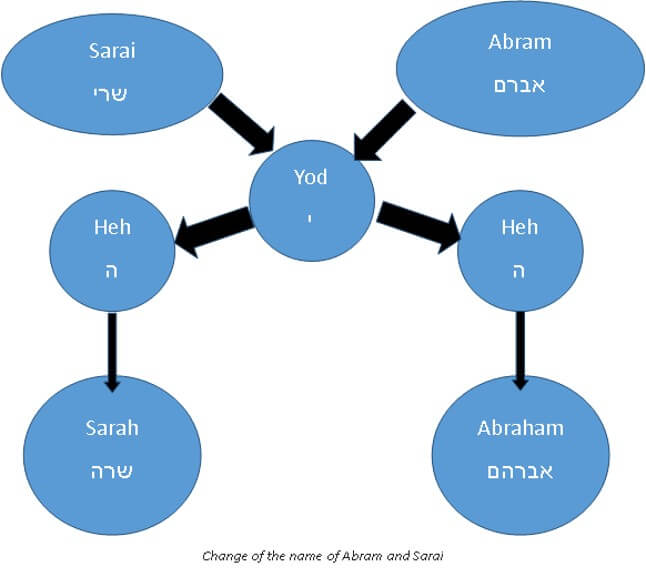
The change of name from Abram, spelled aleph-beth-resh-mem אברם to Abraham, spelled aleph-beth-resh-heh-mem אברהם is effected by inserting a heh ה. Similarly, in the case of Sarah, her original name was Sarai spelled shin-resh-yod שרי ; God instructed it be changed to Sarah spelled shin-resh-heh שרה. If we look at this change carefully, we can see that a yod י has been taken out of Sarai’s name and replaced by a heh. 

It is this insertion of the heh or the ‘5’ into the names of Abraham and Sarah that provides the seed and Crystal of Creation that allows Abraham and Sarah to give birth to Isaac, the second patriarch, the father of Jacob and grandfather to the 12 tribes of Israel. Hence God’s promise to Abraham And I will make you exceedingly fruitful, and I will make nations of you, and kings shall come out of you (Gen. 17:6).

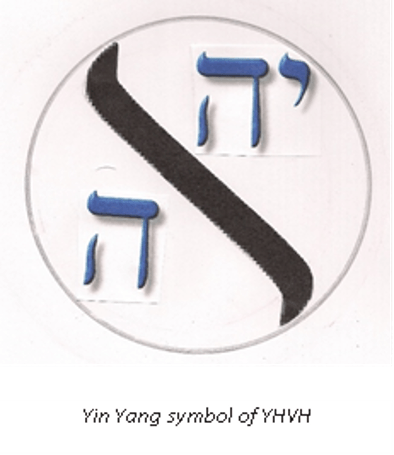
The splitting of the yod into 2 hehs in the renaming of Abram and Sarai, the first patriarch and matriarch, is a direct reflection of the splitting of the lower yod in the letter aleph א to create the unspoken word for God YHVH יהוה .

Thus, the aleph א with its composite of yod-vav-yod י-ו-י evolves into yod-heh-vav-heh י-ה-ו-ה which allows the act of Creation to take place (see yin yang symbols in Chapter 1). On the physical plane, Isaac is therefore the product of this evolution.

The importance of the number 5 and the letter heh in gematrical understanding cannot be underestimated. Its composite 1:4 ratio is the representation of God, the 1, and His relationship with the phenomenal plane, the 4. It is the Crystal of Creation, the Crystal of Life.

It should also be noted that once Abram’s name is changed to Abraham and Sarai’s name to Sarah, there is no further reference to their former names throughout the Bible. This is unlike the case of Jacob whose original name is frequently used even after it is changed to Israel.

Go Forth - Lech Lecha - לך לך

The title of the third parashah in the Book of Genesis opens with the words ‘Lech Lecha’ לך לך meaning ‘Go You Forth’, where Lech לך means ‘go’ and Lecha לך means ‘you yourself’. These are the instructions from God to Abram to …. Go you forth from your country, and from your family, and from your father's house, to a land that I will show you (Gen. 12:1).

The phrase is interesting, inasmuch that Lech – go – would have been sufficient and the additional Lecha, ‘you yourself’ would seem superfluous. God could have simply said the Abram Lech! ‘Go’ as a commandment, and don’t ask any questions.

The Lecha ‘you yourself’ component has strong implications, since firstly this implies possession of man’s own free will, and therefore he has a choice whether ‘to go or not to go’ (vis a vis Jonah). Secondly, the term Lecha implies an embodiment of the commandment, where God has planted the seed of an idea within the mind of Abram, and it is Abram who embeds the idea in his mind and his soul. Bearing in mind that he came from the land of Ur, that lies in the heart of the fertile crescent of Babylon, where the Tigris and Euphrates Rivers meet makes it the most fertile land in the known world, and where he can enjoy all the creature comforts of the then modern age, yet Abram takes the decision to uproot his entire family and to take them to a land based upon an inner feeling.

If one looks at the gematria for Lech Lechaלך לך  lamed-caph, lamed-caph = 30+20= 50 and 30+20=50, one will see that it comprises the doubling of the number 50.  Fifty, as described in Chapter 18, is associated with the Jubilee and the Festival of Shavuoth. Fifty means completion of a cycle, when all things return to the beginning and a new cycle begins. In the Jubilee year, all debts are repaid, land which is leased from its owner is returned to its owner, slaves are given their freedom, and a new cycle of counting begins. Fifty means ‘return’ and ‘renewal’, but return to what and renewal of what?

As indicated in parashah Noah, Abram was 58 years old when Noah died. Hence Noah symbolized the end of the Old World and Abram symbolized the beginning of the new. In accordance with the biblical text, Abram left Ur of Chaldees in Babylon and travelled to Haran together with Sarai, his wife, his father, Terah, and the family of Lot. We do not know what age Abram was when he left Ur - maybe 58 - however we do know that he was 75 years old when he left Haran and entered the Land of Canaan:

 So, Abram departed, as the Lord had spoken to him; and Lot went with him; and Abram was seventy-five years old when he departed from Haran (Gen. 12:4).

Calculating 75-58=17, the entry into the land of Canaan was 17 years after the death of Noah. As we know from Part I, the number seventeen occurs frequently in biblical texts and is the gematrical number meaning ‘good’ and more significantly ‘change’. Hence, in this instance, the radical and historical change of location of Abram from Haran to the Land of Canaan which took place 17 years after the death of Noah is a subsequent event following the end of physical time that took place as a result of the flood and reflected in the name ‘Noah’.

However, this explanation does not explain why in this parasha it is written Lech Lecha, a double 50implying the concept of return and renewal. Yet if we look further to the verses of Gen. 12:7-8:

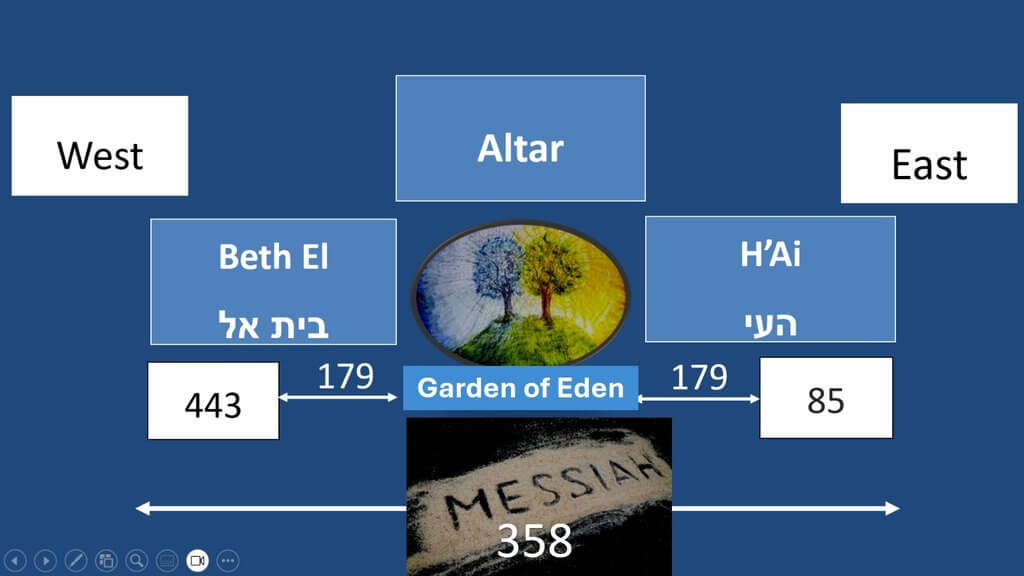
And the Lord appeared unto Abram and said unto thy seed will I give this land: and there builded he an altar unto the Lord who appeared unto him. And he removed from thence unto a mountain on the east of Beth El, and pitched his tent, having Beth El on the west and H’Ai on the east, and there he builded an altar unto the Lord and called upon the name of the Lord.

It can be seen that the point where Abram places the altar is the mid-gematrical distance between Bethel and H’Ai where, Beth El, בת אל meaning the House of God, is spelled; beth-yod-taf-aleph-lamed, and has a gematrical value: 2+10+400+1+30 = 443, and H’Ai  העי spelled: heh-ayin-yod, has a value: 5+70+10 = 85. The gematrical distance between the H’Ai and Beth El is therefore 443-85 = 358. Therefore, the mid-point where Abram’s altar was erected, between these two places is 358/2=179. This is the same gematrical value as the Garden of Eden (Gan B’Eden, גן בעדן spelled: gimmel-nun-beth-ayin-daled-nun = 3+50+2+70+4+50 = 179)[1]. Moreover, 358, which the overall gematrical distance between Bethel and Hai is the value for the Messiah, Mashiach,משיח  spelled: mem-shin-yod-chet = 40+300+10+8 = 358.

Thus, the central idea of Lech Lecha is not so much to ‘Go Forth’ as implied in the English translation, but to return, meaning to return to the Garden of Eden from which Adam and Eve were evicted. The Garden of Eden was ‘the Promised Land’ given to man before forsaking that right by eating of the Tree of Knowledge of Good and Evil and now it is to be returned 2021 years and 20 generations later to Abram and his seed. The promise made by God is reiterated in the following chapter – Genesis 13:14-17 in which He tells Abraham “Lift up now your eyes, and look from the place where you are to the north, and to the south, and to the east, and to the west. For all the land which you see, to you will I give it, and to your seed forever”.

Then the question arises, what is the meaning of the second ‘50’ of Lech Lecha? It implies that not only is there the renewal and return in the form of going back to the Garden of Eden but further, the renewal in the form of the coming of the Messiah, and that this land is the land of the Messiah.


[1] Several hundred years later, at the time of the exodus, Joshua in his assault on the city of H’Ai, and after successfully conquering Jericho, finds himself in exactly the same place: ‘Joshua therefore sent them forth; and they went to the place of ambush, and stayed between Beth-El and Ai, on the west of Ai’; (Joshua 8:9). Joshua therefore also realises the implications of the place that he was about to conquer and where God had told Abram to establish his altar to be the heart of the Land of Canaan and the Garden of Eden where the Messiah will appear.

Why was Miriam a prophetess?

The Song of the Sea (Ex 15:1-22) gives voice to the victory of the Children of Israel over the Egyptians after 400 years of slavery. It took place on the 8th day after leaving Egypt, the day of renewal, the day of covenant with God. When this passage is read in synagogue, the entire congregation stands up in recognition of this event. It is also the first occasion in the Torah that we find joyousness expressed through singing and dancing. Let us examine aspects of this event in detail. It is written:

Thus, the Lord saved Israel on that day from the hand of the Egyptians; and Israel saw the Egyptians dead upon the seashore (Ex. 14:30).

Then:

And Miriam the prophetess, the sister of Aaron, took the tambourine in her hand; and all the women went out after her with tambourines, dancing (Ex. 15:20).

Various questions arise from these two verses: Why does it say, ‘on that day’ very definitively and why does the text state ‘Miriam the Prophetess’? What did she prophesy? Many rabbinical texts have discussed this point, but few have come to a satisfactory conclusion. The secret is in the 'tambourine'. If we look at the Hebrew text we see that Miriam not only took up the tambourine, but it says THE tambourine et ha tof את התף where grammatically the word et is emphatic, pointing to not just a tambourine but the specific tambourine.

All these questions are answered in I Kings 6:1

And it came to pass in the four hundred and eightieth year after the people of Israel came out of the land of Egypt, in the fourth year of Solomon's reign over Israel, in the month Ziv, which is the second month, that he began to build the house of the Lord.

The word for drum, tof, is spelled taf-peh תף whose gematrical value is 80+400=480. Hence Miriam, by taking up Et ha Tof ‘the drum’ was a prophetess because she was using the drum to announce the future construction of the Temple 480 years later under King Solomon. It was 'on that day', the number of years from the 8th day after the the First Passover, that the construction of the temple by Solomon began.

The joyousness of singing and dancing was because the Children of Israel realized that, as Moses had stated each time he confronted Pharaoh saying Let my people go, that they may serve Me, freedom was to become to a reality. Indeed, the greatest event in Jewish history after entry into the Promised Land was the construction of Solomon’s Temple: a home for the Lord God of the Hebrews who entered the sanctum in a cloud:

And that the priests could not stand to minister because of the cloud; for the glory of the Lord had filled the house of the Lord (I Kings 8:11).

Why did Moses divide the tribe of Manasseh?

In Numbers 32: 33 no reason is given why Moses decides to split the tribe of Manasseh that they settle together with the tribes of Gad and Reuben on the other side of the Jordan. It is because Manasseh is the anagram of Neshamah = soul.

The essence of the story is that man (Adam) only comes alive when the heavenly soul, the neshamah, joins with the bodily soul, nefesh (Genesis 2:7). He cannot live, and is not alive, without the neshamah, and without the neshamah he is no more than flesh and bones.

Whilst Joseph was the neshamah of the 12 twelve brothers, his two children Ephraim and Manasseh were the nefesh and the neshamah. Ephraim was the nefesh of the two and was more ‘dynamic’ and closer to earthly matters. It was for this reason that Jacob (Israel), in his blessing of the two sons, placed preference on Ephraim over Manasseh (Gen. 48:14) foreseeing the need for earthly action during the coming generations. Manasseh was the neshamah of the two brothers and after the passing of Joseph becomes the main link between the tribes of Israel and God. The name Manasseh spelled mem-nun-shin-heh מנשה  is an anagram of neshamah spelled nun-shin-mem-heh נשמה – it is also an anagram of the word ‘Mishnah’ mem-shin-nun-heh משנה – a systematic analysis of Jewish halachic laws.

We see the significance of the role of Manasseh in Numbers 32 where the tribes of Gad and Reuben pleaded with Moses not to cross the River Jordan to the Land of Canaan with the rest of the Children of Israel and to remain on the east side of the Jordan River because the pastures there are good for their herds.

The sons of Gad and the sons of Reuben came and spoke to Moses, and to Eleazar the priest, and to the princes of the congregation, saying……: Therefore, said they, if we have found grace in your sight, let this land be given to your servants for a possession, and bring us not over the Jordan (Num. 32: 2 and 5).

Moses agreed, but on the condition that half the tribe of Manasseh go with them:  

And Moses gave to them, to the sons of Gad, and to the sons of Reuben, and to half the tribe of Manasseh the son of Joseph, the kingdom of Sihon king of the Amorites, and the kingdom of Og king of Bashan, the land, with its cities in the borders, even the cities of the country around (Num. 32:33). No reason whatsoever is given in the Torah for this division of the tribe of Manasseh, whereby half the tribe lived on the east side of the Jordan River and the other half on the west with the other 10  tribes of Israel. But from the above analysis we can see that the tribe of Manasseh was the neshamah of Israel; it was the connecting force between the Children of Israel and God. Were the tribes of Gad and Reuben separated from the other tribes without the neshamah, they would surely dissolve into the tribal communities of the region. The splitting of the tribe of Manasseh effectively created a bridge of the neshamah between the nation of Israel, ensuring that the tribes of Gad and Reuben would be linked to God. Not only is man but also a nation is unable to live without the neshamah.

Moreover, both Manasseh and neshamah have the same Gematria =390 =shemayim = heaven meaning that the tribe of Manasseh are not only connecting the tribes of Gad and Reuben with teh other 10 tribes of Israel but also connecting Israel with Heaven. This did not happen when the tribes of Israel split into Judah and Benjamin and the 10 tribes after the death of Solomon (I Kings 12:12-21).

[1] The bridge of the neshamah created by the half tribe of Manasseh between the tribes of Gad and Reuven did not last more than a few generations for in I Chronicles 5 reads: 25. And they (half tribe of Manasseh) transgressed against the God of their fathers, and played the harlot after the gods of the peoples of the land, whom God destroyed before them: 26. And the God of Israel stirred up the spirit of Pul king of Assyria, and the spirit of Tilgath-Pilneser king of Assyria, and he carried them away, the Reubenites, and the Gadites, and the half tribe of Manasseh, and brought them to Halah, and Habor, and Hara, and to the river Gozan, till this day:.

Aleph, the Big Beth ב and the BIG BANG?

The first phrase in the Bible is ‘In the beginning'. In Hebrew, it is Barashit בראשית. The first letter is beth ב and if one looks closely one will note that the beth ב is a very large beth. This opens two questions: Why is the first letter a beth ב and not aleph א and why is it enlarged? One would normally expect the first letter of the Bible to be the first letter of the alphabet, yet it begins with the second letter. Beth has a gematrical value of 2, meaning the beginning of the world of duality, and the end of singularity. It is the initiation of the process of Creation, the transformation of the ‘oneness’, described as ‘void and chaos’ in Genesis 1:2), into dualistic forms: light and darkness, Heaven and Earth, land and water and waters above the Earth and waters below the Earth, as described in the six days of Creation. Hence the letter beth ב, with its gematrical value of 2, indicates the process of Creation.

Moreover, the enlarged beth ב is not just for decoration or because it is the first letter of the Holy Bible but because it has a special meaning (See Fundamental of Gematria). In this instance, the large beth ב means a BIG BANG means the creation of a dualistic universe, in whatever form we understand it to have taken place. It was the division of the aleph א, the one - into two.

Why does the Bible not begin with the letter aleph א? Aleph א, the first letter of the alphabet, has a value of 1. The unity of the letter א symbolizes the one and only God, the Creator in a physical form and who existed before the creation. It represents the most primordial form of God, the power of the universe from which all things emanate. The aleph א always was, is, and will be.

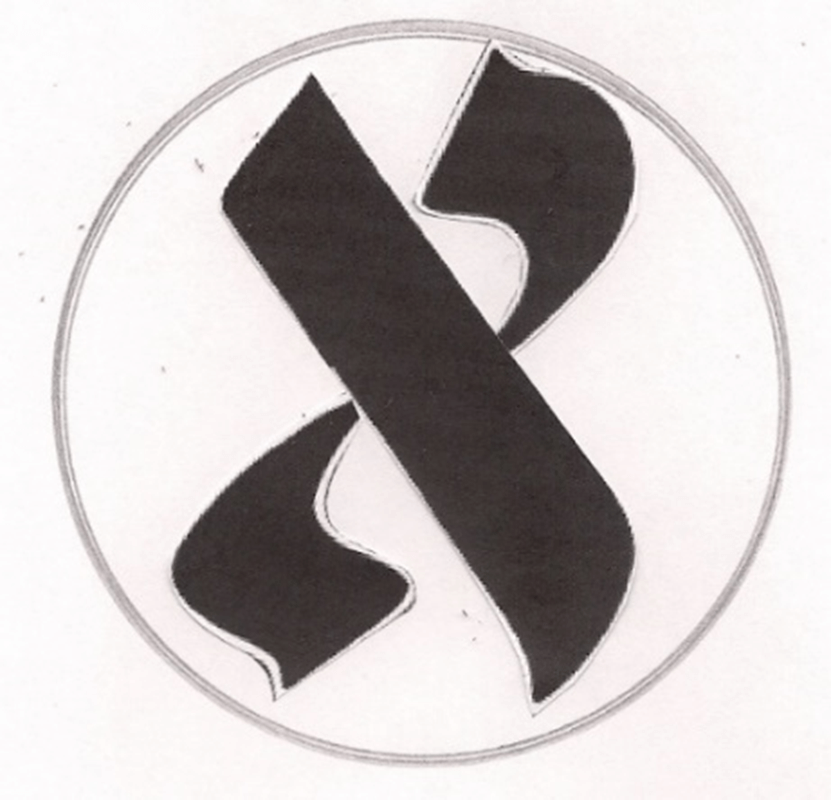
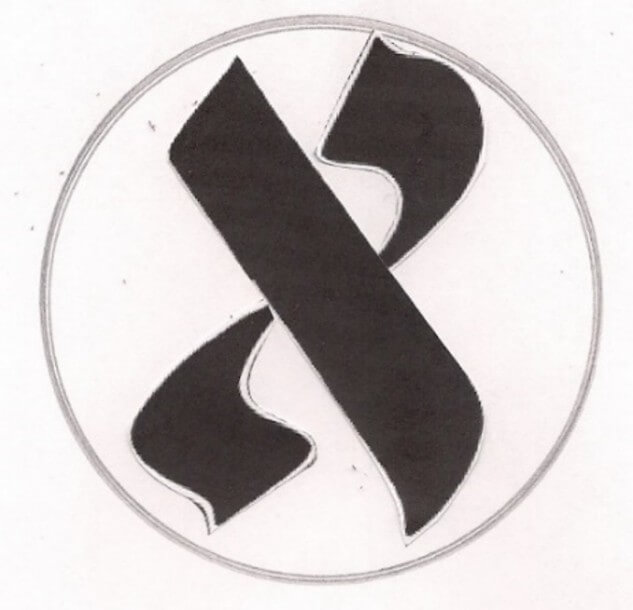
The aleph א is the singularity, but if we examine the letter carefully, we can find duality inherent in the structure of the aleph א. It is a composite of three letters of the Hebrew alphabet, where the letter yod י on the upper right side and lower left side are linked by the letter vav ו across the center. The letter vav ו means a hook (See Table 1).  Yod י has a value of 10 and is one decane above the value of aleph 1. Therefore, just as aleph א represents God in primordial form, so yod י represents God in conscious form. The letter aleph א with the two yods יי and a vav ו, therefore depicts the conscious form of God in Heaven and the conscious form of God on Earth, with the two forces drawn together by a hook.

The Aleph, comprising two yods separated by a vav

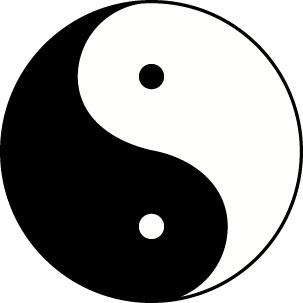
Moreover, if one draws a circle around the letter aleph א one obtains the familiar yin-yang pictogram, which represents the world in its state of duality and in a state of change. In this pictogram, the circle around the pictogram is the universe and the two black and white halves contained in the circle represent the two states of universal opposites in the world, where the white half is yang and the black half is yin. The universal opposites may take many forms: yang is good, heaven, above, hot, male, and creative; yin is evil, earth, below, cold, female, passive, etc. The containment in the circle demonstrates the limitations of the dualistic world, so that if one of the opposites expands, the other, by default, contracts. For example, when there is more ‘good’ in the world, there is less ‘evil’, and vice-versa. The dynamics of yin and yang in the universe are the dynamics of change. If yang increases, then yin will diminish. However, as the yang increases, so the pressure of the yin upon the yang increases to a point that the force of the yang ultimately decreases. To extrapolate further: if ‘good’ increases in the world, then ‘evil’ will decrease; however, with the decrease, the ‘pressure’ of ‘evil’ will increase to the point where it counters ‘good’ and returns to dominance. Good exists because evil exists and vice versa. Without evil, good would not exist.

The Yin -Yang Pictogram

The Garden of Eden, Adam and the 1+4 Principle

In the first two chapters of the book of Genesis, there are two stories of creation. The first describes the familiar six days of creation and the second begins in Gen. 2:6 with the phrase: a mist rises off the face of the Earth and watered the whole face of the ground. The word for mist in Hebrew is ed spelled aleph-daled אד and has the gematrical structure of 1+4.

We then learn that the mist forms water over the face of the Earth and divides into 4 rivers which flow from the Garden of Eden and spread all over the Earth

And a river went out from Eden to water the garden, and from there it was divided and became four rivers (Gen. 2:10).

Hence the form of the word mist, with its 1+4 values, is represented in the physical form of the 4 rivers coming from a single source in the Garden of Eden. Simplistically, the 1+4 relationship represents the ‘1’ – who is God - creating the physical plane, the Earth and Universe, which is the ‘4’.

The relationship between 1 and 4 is extended with the creation of man, Adam (As we know from the text in the Bible, Adam אדם was created from the ground or soil. The word for ground/soil in Hebrew is adama אדמה; it is for this reason that the Hebrew word for ‘man’ is Adam). Adam, meaning ‘man’ in Hebrew, spelled aleph-daled-mem אדם has the gematrical structure 1-4-40. Thus ‘man’ is effectively the ‘mist’ to which a 40 has been added. As described earlier, the Hebrew alphabet progresses from units (1-9) to decanes (10-90) to centanes (100-400). So, while 4 represents the phenomenal plane, 40 represents the conscious plane, or in this case, the consciousness of man. Hence man, or ‘adam’ אדם, with the gematrical form 1-4-40 is made of: ‘1’ which is God, the unity and singular force of the universe, ‘4’ which is His physical form, and ‘40’ the power of intelligence or consciousness.

To extend this argument further, we can assume that man’s purpose on this Earth is to find truth (or, more in accordance with the story of Adam eating the apple, to re-find truth) and to align himself ultimately with God.

‘Truth’ is emet אמת in Hebrew, spelled aleph-mem-taf with the gematrical structure 1-40-400. So once again we see the number 4 reappearing and taken to the centane level, which is the spiritual plane. The ‘400’ is taf ת the last letter and highest value in the Hebrew alphabet. It indicates the highest level of spiritual consciousness that is possible in this physical universe. The 1-40-400 structure of the word truth therefore implies that truth comprises: the ‘1’ which is God, ‘40’ which is consciousness or intelligence and ‘400’ the highest spiritual level that can be reached on this earthly plane.

The implication of this structure is that man can only reach this highest level of spiritual consciousness (400) through the 1, God, which can be achieved through the intelligence or consciousness of man (40).

If we examine this further, the word for ‘dead’ in Hebrew is met מת and spelled mem-taf, with a gematrical structure 40-400. It is the same as ‘truth’ except without the aleph א. Hence an attempt to find ‘truth’ through the application of intelligence or even spiritual learning, but without the acknowledgment of God, will lead to death: unless knowledge is related and linked to the original power of God, it is not truth; it is death.

In a similar context, the word for ‘blood’ in Hebrew is dam דם and is spelled daled-mem with a gematrical structure 4-40. It is the same as the Hebrew word for adam אדם except it is without the 1, meaning that man, without God, is simply blood and flesh.

The Crystal of Creation 1+4=5 = Heh ה

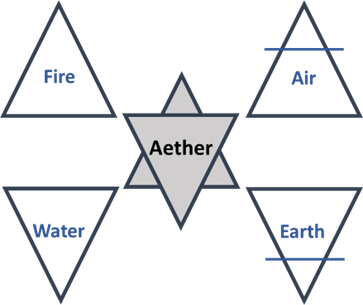
The 1+4 sequence reoccurs repeatedly in the two stories of Creation in Genesis Chapters 1 and 2 (see The Tree of Knowledge of Good and Evil and The Garden of Eden, Adam and the 1-4 principle) and is consistent with the five elements – Earth, Air, Fire, Water, and Aether – which dominate esoteric understanding of the compositional elements of the universe. Whereas the four elements are associated with the physical domain, the fifth element, Aether, or Quintessence, as termed by Aristotle, is an unchanging force associated with the heavens. Aristotle may have easily borrowed the concept from pre-existent cosmology in Hinduism, as Akash; the Bonh religion of Tibet, as Dharmakay; and also in Japanese philosophy as Ku, all of which perceive the fifth element to be non-physical and is identified as void, space or nothingness. Interestingly, the symbol given to the fifth element is the six-pointed Star of David. If one examines the Star of David carefully one will note that it is a composite of two triangles and a cross-line which are the symbols of the other four elements and therefore unifies these elements into one and is consistent with the 1-4 principle. 

The Five Elements

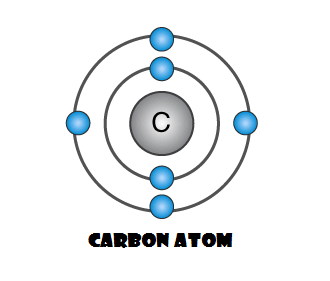
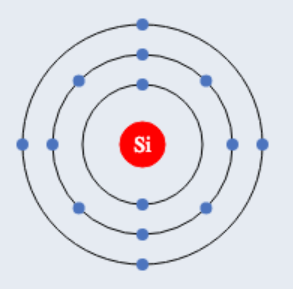
The 1+4 principle is also found in the basic elements of nature. Carbon, from which all life is formed, has an atomic structure of a nucleus with 4 electrons in the outer shell, giving a 1-4 structure. It is this structure, in which the nucleus demands a total of 8 electrons in order to be stable, which is the foundation for all organic chains of carbohydrates, amino acids, and life! Similarly, Silicon, the foundation of all primordial rocks, also has a 1-4 structure of 4 electrons in the outer shell and 1 nucleus, leading to the formation of the multiple rock types we find in this universe. So, we can see that the 1-4 principle is indeed the foundation of nature on Earth and indeed of the universe. The number 5 represents the Crystal of Creation.

Carbon Atom with 1 nucleus and 4 outer electrons
How the 1+4 sequence shown in the second story of creation in reflected in our natural world
Silicon atom with 1 nucleus and 4 outer electrons

Tree of Knowledge of Good and Evil and the 1-4 principle

The significance of 1 and 4 in the second story of creation is described in https://thealeph.leonvdk.com/uncategorized/the-garden-of-eden-adam-and-the-14-principle/. This is further emphasized in the story in Genesis 2 where there were two trees in the Garden of Eden, the Tree of Life and the Tree of Knowledge of Good and Evil. If we look at the gematrical values of these two phrases:

Tree of Life ‘Etz ha Haim’ עץ החיים spelled  ayin-tzadek-heh-chet-yod-yod-mem is 70+90+5+8+10+10+40 = 233

Tree of Knowledge of Good and Evil’ Etz hadaat tov ve raa עץ הדעת טוב ורע  spelled ayin-tzadek-heh-daled-ayin-taf-tet-vav-beth-vav-resh-ayin is 70+90+5+4+70+400+9+6+2+6+200+70= 932

Dividing these two values: 233/932 we get a ratio of 1:4, exactly:

The philosophical implication of this gematrical revelation is that we have (or had) two choices in life: the option which Adam chose not to take – the path of ‘the one’, or the path that he was seduced into taking and that is the path of ‘the four’.

The world of ‘the four’ is the phenomenal plane of development and multiplicity in which we live as a result of Adam’s choice; it is a path which, unless taken in the context of God (the 1), is the path of death (See https://thealeph.leonvdk.com/uncategorized/the-garden-of-eden-adam-and-the-14-principle). Or we may select the path of the ‘1’, returning to the Garden of Eden with the realization that expansion of the inner self as related to God brings us to truth. It is a choice that we all have to make in our lives.