Why was Miriam a prophetess?

The Song of the Sea (Ex 15:1-22) gives voice to the victory of the Children of Israel over the Egyptians after 400 years of slavery. It took place on the 8th day after leaving Egypt, the day of renewal, the day of covenant with God. When this passage is read in synagogue, the entire congregation stands up in recognition of this event. It is also the first occasion in the Torah that we find joyousness expressed through singing and dancing. Let us examine aspects of this event in detail. It is written:

Thus, the Lord saved Israel on that day from the hand of the Egyptians; and Israel saw the Egyptians dead upon the seashore (Ex. 14:30).

Then:

And Miriam the prophetess, the sister of Aaron, took the tambourine in her hand; and all the women went out after her with tambourines, dancing (Ex. 15:20).

Various questions arise from these two verses: Why does it say, ‘on that day’ very definitively and why does the text state ‘Miriam the Prophetess’? What did she prophesy? Many rabbinical texts have discussed this point, but few have come to a satisfactory conclusion. The secret is in the 'tambourine'. If we look at the Hebrew text we see that Miriam not only took up the tambourine, but it says THE tambourine et ha tof את התף where grammatically the word et is emphatic, pointing to not just a tambourine but the specific tambourine.

All these questions are answered in I Kings 6:1

And it came to pass in the four hundred and eightieth year after the people of Israel came out of the land of Egypt, in the fourth year of Solomon's reign over Israel, in the month Ziv, which is the second month, that he began to build the house of the Lord.

The word for drum, tof, is spelled taf-peh תף whose gematrical value is 80+400=480. Hence Miriam, by taking up Et ha Tof ‘the drum’ was a prophetess because she was using the drum to announce the future construction of the Temple 480 years later under King Solomon. It was 'on that day', the number of years from the 8th day after the the First Passover, that the construction of the temple by Solomon began.

The joyousness of singing and dancing was because the Children of Israel realized that, as Moses had stated each time he confronted Pharaoh saying Let my people go, that they may serve Me, freedom was to become to a reality. Indeed, the greatest event in Jewish history after entry into the Promised Land was the construction of Solomon’s Temple: a home for the Lord God of the Hebrews who entered the sanctum in a cloud:

And that the priests could not stand to minister because of the cloud; for the glory of the Lord had filled the house of the Lord (I Kings 8:11).
Purim and the Moon

Why did Queen Esther decide to host Haman at two banquets?

In the Scroll of Esther, we note that Queen Esther holds two banquets for King Ahasuerus and the Evil Haman. They are held one day after the other and became the turning point of the whole story of Purim. In the first banquet, Haman comes out as a hero, praised by the king, hosted by the Queen and everything is in his favor. Yet in the second banquet, Queen Esther reveals her Jewish identity and that Haman’s plan to slaughter all the Jews would mean that she herself would die.

Between these two banquets, it is midnight, and the King is unable to sleep and reads the annals of the kingdom and discovers that Mordechai, Esther’s uncle had saved his life from an assassination attempt, yet no honor was given to him. Meanwhile, the Evil Haman is preparing a gallows for Mordechai to hang him because he is a Jew. When King Ahasuerus is determined to give Mordechai honor, whilst Haman is plotting his death, Haman realizes all is lost. Indeed, he is hanged on the gallows he had built for Mordechai. The swift change in fate plays out like Shakespearian theatre.

If we examine the biblical text, it suggests that this sudden change of fate is related to the moon. Moreover, it has similarities to the 10th Plague of Egypt and the downfall of the Pharoah.

From the text, we see Mordechai and Esther’s intervention in annulling Haman’s edict to annihilate the Jews must have taken place in the 13th year of the reign of king Ahasuerus between 13th of the 1st month when the edict was issued and 23rd Sivan (3rd month) when Mordechai is given the signet ring of King Ahasuerus which he uses to counter the edict.

Then were the king's scribes called at that time in the third month, that is, the month Sivan, on its twenty-third day; And it was written according to all that Mordecai commanded to the Jews, and to the satraps, and the governors and the princes of the provinces which are from Hodu to Kush, one hundred twenty and seven provinces, to every province according to its writing, and to every people in their own language, and to the Jews according to their writing, and according to their language (Esther 8:9).

Let's use gematrical analysis to examine the sequence of events leading up to the 23rd of Sivan and the dates that they probably took place. The redemption of the Jews in the story of Purim event has some similarities with the story of Hanukah. Therefore the 8th day of Hanukah would correspond to the 23rd of Sivan. If that is the case, then the two banquets would have taken place 8 days before that, i.e. 14th and 15th Sivan. The fast of Esther would therefore have begun on the 10th Sivan until 14th Sivan. Moreover, the critical event when King Ahasuerus, upon reading the chronicles, realizes that Mordechai, whom Haman was about to hang at the gallows, had saved his life, would have taken place at midnight of the 14th Sivan. This would be at the time of the full moon when the moon was shifting from the waxing to the waning phase.

The sequence is very reminiscent of Passover (see Chapter 16). In the preparation of the pascal lamb, it is separated from the flock on the 10th day of Nissan and then it is consumed during the Passover at midnight on the 14th of Nissan when the Angel of Death is passing over Egypt.

In both events, the three days between the 10th and the 14th of the month is the period of contemplation before the offering. It is the period during which Esther (and the Children of Israel) underwent deep contemplation and repentance in order to re-find the God who had been hidden so many years. At the same time, as in the case of Passover, it is when God prepares to reveal His greatness to the people.

Then Esther bade them return Mordecai this answer: Go, gather together all the Jews who are present in Shushan, and fast for me, and neither eat nor drink three days, night or day; I also and my girls will fast likewise; and so will I go to the king, though it is against the law; and if I perish, I perish (Esther 4:15-16).

On the 14th of Sivan, the eve of Esther’s first banquet to ‘honor’ Haman, and when Haman is plotting to hang Mordechai at the gallows, the moon is still reaching its zenith and the yin force is on its ascent. So, just as in Egypt, just before the 10th plague, the power of Pharaoh was still dominant, in Shushan the power of Haman reigns. At midnight on the 14th of Sivan the moon begins to wane, the yin force declines, the Angel of Death passes over Egypt, Ahasuerus rediscovers Mordechai’s good deeds in the Annals of the kingdom and the fate of Haman is sealed, and subsequently signed at the second banquet.

There is then a period of 8-days rebirth, renewal, and redemption, during which Mordechai prepares to change from a man condemned to death to a Minister of the realm of Ahasuerus. On the eighth day, he takes up the signet ring of King Ahasuerus. He reverses the edict of Haman and the entire Jewish nation in Babylon is saved from annihilation.

Passover: Why Did Pharaoh Throw the Hebrew Babies into the River?

The story of Passover begins with the birth of Moses and is about fire and water. We ask ourselves, why did Pharaoh throw the Hebrew babies into the river? Why did he not kill them by the sword or simply strangle them? Why was Moses placed, in an ark, in the river? Why was Moses called Moses? What is the meaning of the burning bush?

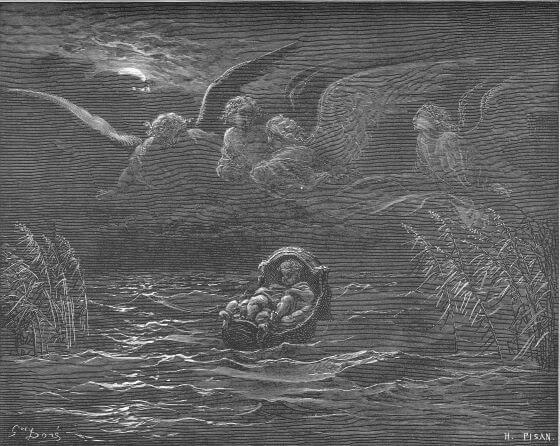
Moses in the Bulrushes

The reason given in the Bible is that Pharaoh feared the strength and number of the Hebrew people and therefore sought to kill the male children to prevent them amassing an army to overthrow him (Ex. 1: 7-22).

And Pharaoh charged all his people, saying: Every son who is born you shall throw into the river, and every daughter you shall let live (Ex. 1:22).

Pharaoh was not so much afraid of the multitude of the Hebrew people, but the male force. However, the matter goes deeper than this. The Egyptian astrologers knew that a great leader was to be born. In Exodus 2:2-3 it is written:

And the woman conceived, and bore a son; and when she saw that he was a handsome child, she hid him three months (yerachim ירחים): And when she could no longer hide him, she took for him an ark made of reeds, and daubed it with slime and with pitch, and put the child in it; and she laid it in the rushes by the river's brink.

In the Hebrew text, the term for 3 months is 3 ‘moons’ (Heb: yerachim). It is one of two instances in the Torah where the moon is used as a period of time. In all other instances, the term for month is hodesh, from the word hadash, meaning ‘new’. Why is the word ‘moonth’ used in this instance?

Moses lived at the time of the New Kingdom (16th - 11th century BCE), whose capital was Thebes, represented today by the great Temple of Karnak. At that time, Khonsu, the Ancient Egyptian god of the moon, was considered "the Greatest God of the Great Gods". He was the god who created all new life in all living creatures, yet also slew Pharaoh's enemies. The Egyptians were great astrologers. Through Khonsu the astrologers could see that a Hebrew child had been born into the world and would threaten Pharaoh’s power, hence the need to slaughter all newborn Hebrew male children. For this reason, it is said that after ‘3 moonths’ Moses’ mother could no longer hide him as the astrologers could detect the place where he was hidden.

But why were the Hebrew children thrown into the river?

Fire and Water:

Throughout the texts of the Bible, the term fire and burning is always associated with destruction, except in the case of the Hebrew people who were always protected by fire. God is described as an ‘all-consuming fire’ (Deut. 5:4 and 9:3-20). God spoke with Moses ‘out of the midst of the fire and had no form’ when pronouncing the Ten Commandments (Deut. 9:10-42). Moreover, during the exodus to the Land of Canaan, God guided the Children of Israel in a pillar of fire. Fire protects the Hebrew people.

The Egyptian astrologers knew that the Hebrew God was an all-consuming fire that protected the Hebrew people and they had to determine a way to destroy this boy-king at birth. The only element that could destroy fire was water, and Khonsu, the Egyptian god of the moon, was symbolized by water. The astrologers believed that the Hebrew God, the god of fire, had no means to combat the strength of water. It is for this reason that the Pharaoh made the decision to throw the boy-children into the water.

In order to deceive the astrologers Moses was put into the element that was to destroy him, i.e. water, and therefore, in their astrological search, they would believe him dead. Moreover, he was placed in an ark ‘disguised’ by being made of the reeds from the river and daubed with ‘slime and pitch’.


The Egyptian magicians ability to perform magic was limited to the water element. Thsi was why they were also able to perform the first two of the Ten Plagues but not the third. The first two involved the water element, but the other plagues were based upon the other elements of Earth, Air, Fire, and Aether!