Why did Reuben sleep with his father's concubine, Bilhah
An extraordinary verse appears immediately after the death of Rachel, Jacob’s dearest wife, whilst giving birth to Benjamin.
And it came to pass, when Israel dwelt in the land, that Reuben went and lay with Bilhah his father’s concubine: and Israel heard it. Now the sons of Jacob were twelve (Gen. 35:22).
Three questions arise: (i) why are the different names Israel and Jacob usedeven though the two sentences are adjacent to each other? (ii) why did Reuben venture to sleep with Rachel’s maidservant, Bilhah? and (iii) why are we told ‘out of the blue’ that the sons of Jacob are twelve?
After Reuben sleeps with Bilhah, the Bible states ‘And Israel heard it” and immediately afterwards it states: “Now the sons of Jacob were twelve”. For this act Reuben, the first born, is chastised by Israel not only in this instance, but also in his blessing of Reuben at the time of Jacob’s death.
Reuben thou art my firstborn, my might and the beginning of my strength, the excellency of dignity, and the excellency of power: Unstable as water, thou shalt not excel, because thou wentest up to thy father’s bed and then defilest thou it; he went up to my couch (Gen. 49:3-4).
Reuben lost favor with his father ever since even until his death, so why did he do it? As we have seen previously, Reuben, as the firstborn, was always very concerned about the fertility of his parents and the number of his brothers. In the incident of the mandrakes it is Reuben who delivers the mandrakes to his mother Leah after the birth of Asher, the 8th child. It is Reuben who sees that his mother has stopped becoming pregnant. He knows that Rachel is barren and so he tries to induce pregnancy of his mother by using mandrakes. Later in the story the mandrakes get passed on to Rachel, giving rise to the birth of Joseph (Chapter 8).
Reuben understood that there should be thirteen sons of Jacob, - and therefore 13 tribes of Israel - and not twelve, and that the 13th son should be from Rachel’s womb, or at least from her maidservant’s, which would count as the same thing[1]. So, after the death of Rachel he takes Rachel’s maidservant, Bilhah, and sleeps with her, hoping to increase the number of the tribes of Israel to 13. Hence, the sentence: “Now the sons of Jacob were twelve”. This ploy was not successful, and Bilhah does not become pregnant.
Later, we again see Reuben’s concern over the number of brothers and tribes of Israel. When his brothers intend to slay Joseph, it is Reuben who desperately tries to save him that he might deliver him to his father again.
And Reuben heard it, and he saved him from their hands; and said, Let us not kill him: And Reuben said to them, Shed no blood, but throw him into this pit that is in the wilderness, and lay no hand upon him; that he might rid him from their hands, to deliver him to his father again (Gen. 37:21-22).
Reuben’s concern and despair is further realized when he returns to the pit into which Joseph was thrown and finds him gone, for if Joseph is slain there would only be 11 sons.
And Reuben returned to the pit; and, behold, Joseph was not in the pit; and he tore his clothes (Gen.37:21-22).
However, it is God who decides how and when there should be thirteen tribes of Israel, as indeed He does through the birth of Ephraim and Manasseh, the sons of Joseph, who indirectly come through Rachel’s womb. Jacob very explicitly incorporated Ephraim and Manasseh into the tribes of Israel when he blessed them on his deathbed, saying:
And now your two sons, Ephraim and Manasseh, who were born to you in the land of Egypt before I came to you to Egypt, are mine; as Reuben and Simeon, they shall be mine: And your issue, born to you after them, shall be yours, and shall be called after the name of their brothers in their inheritance (Gen. 48:5-6)
In thee shall Israel bless, saying God make these as Ephraim and Manasseh (Gen. 48:20).
Here again we see that when Reuben sleeps with Bilhah and in the blessing of Ephraim and Manasseh, the name ‘Israel’ is used instead of Jacob. Moreover, Jacob states very clearly that any sons born after Ephraim and Manasseh shall not be numbered as Jacob’s offspring, but shall be Joseph’s.
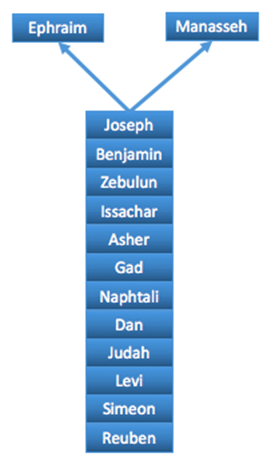
The tribes of Israel can best be described in the diagram below, where Joseph fits the blessing of Jacob, saying:
Joseph is a fruitful bough, a fruitful bough by a well; whose branches run over the wall (Gen. 49:22).
The very structure of the diagram shows that the two sons of Joseph are indeed like a fruitful bough whose branches run over the wall. What does it mean? The tribes of Israel are like a tree that continues to develop, evolve, change, learn, invent, explore into the unknown over the wall and go through continual renewal.
Moreover, 13 is the gematrical value of the letter of the word ‘one’ achad, אחד , showing that the thirteen tribes possess unity within their diversity. Thirteen is half the value of the components of the letter aleph א, and of the tetragrammaton YHVH both of which have a value of 26; thirteen denotes the qualities of God and, not least, 13 is the gematrical value for love, (see Chapter 1).The unity of the thirteen tribes of Israel on earth is complemented by the unity of God in Heaven and that unity is the unity of LOVE.
Twelve is a static number; there is no growth, evolution or development. It is confined and limited; it has no movement or change. Twelve is the measure of the phenomenal world, whereas thirteen is the measure of unity. Twelve is for the tribes Ishmael:
And as for Ishmael, I have heard you; Behold, I have blessed him, and will make him fruitful, and will multiply him exceedingly; twelve princes shall he father, and I will make him a great nation (Gen. 17:20).
[1] According to Nuzi tablets in the Mesopotamia region, it was common for a wife to give her maidservant to her husband should she be barren; a child of a maidservant would be treated as a child of the wife.